
Wondering what are industrial robots and normal robots? Walk into a modern automobile factory and you may see robotic arms welding car bodies, painting vehicle panels, moving components, assembling parts and inspecting finished products.
In another factory, robots may load and unload CNC machines, package products or stack hundreds of boxes onto pallets.
These machines are Industrial Robots.
An industrial robot is an automatically controlled, reprogrammable, multipurpose manipulator that can be programmed in three or more axes for automation applications in an industrial environment. They perform repetitive, precise, heavy, hazardous and high-speed tasks with programmable motion.
According to the International Federation of Robotics (IFR), 542,000 industrial robots were installed worldwide in 2024, more than twice the annual installation level of a decade earlier. India alone installed a record 9,100+ industrial robots in 2024, an increase of about 7% from 2023.
For example, the same basic robotic-arm platform could potentially be configured for:
- Welding
- Painting
- Material handling
- Assembly
- Machine tending
- Palletizing
- Packaging
- Cutting
- Grinding
- Dispensing
- Inspection
The robot itself is only one part of the system. A complete industrial robotic application can also include a controller, sensors, end-of-arm tooling, fixtures, conveyors, safety equipment and communication systems.
How Do Industrial Robots Work?
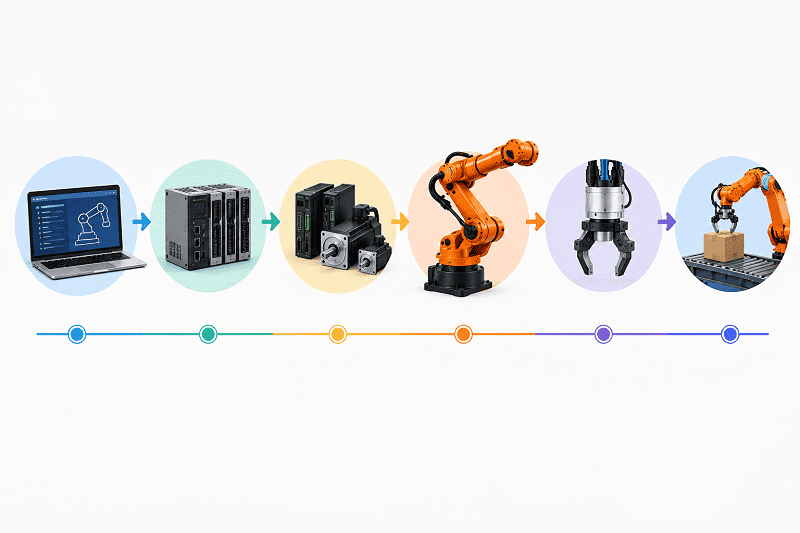
An industrial robot follows programmed instructions through a combination of mechanical components, motors, controllers, sensors and software. A simplified industrial robot working process looks like:
Program → Controller → Drives/Motors → Robot Joints → End Effector → Task
1. Programming
The required movement or task is programmed into the robot controller. Depending on the robot and application, programming may be performed using a teach pendant, offline programming software or other control interfaces.
2. Controller
The controller acts as the robot’s central control unit. It interprets programmed instructions and coordinates the robot’s movements.
3. Drives and Motors
Motors and drive systems generate the movement required at the robot’s joints or linear axes. Servo systems are commonly used where controlled position, speed and repeatability are important.
4. Robot Arm and Joints
The mechanical structure provides the robot with its range of movement. Different robot designs use different combinations of rotary and linear axes.
5. Sensors
Sensors can provide information about position, force, vision, proximity, safety conditions and other aspects of the application. Modern robotic systems can combine robot motion with cameras, laser sensors and other sensing technologies.
6. End Effector
The end effector is the device attached to the robot that actually interacts with the workpiece.
Examples include:
- Welding torch
- Gripper
- Vacuum cup
- Paint spray gun
- Cutting tool
- Grinding tool
- Screwdriver
- Dispensing nozzle
Therefore, a robot used for welding and a robot used for painting may have a similar robotic arm but completely different end-of-arm tooling and surrounding equipment.
Main Types of Industrial Robots
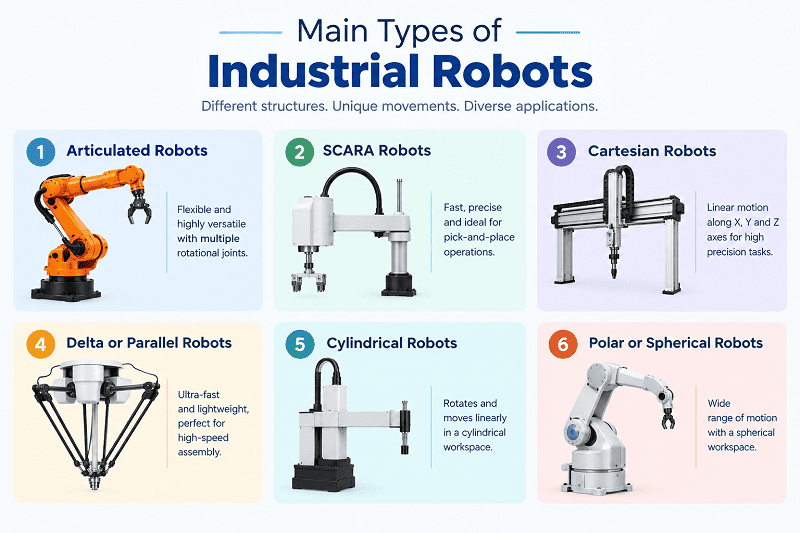
Industrial robots can be classified according to their mechanical structure, movement and application. The major types include:
- Articulated robots
- SCARA robots
- Cartesian robots
- Delta or parallel robots
- Cylindrical robots
- Polar or spherical robots
1. Articulated Robots
An articulated robot uses rotary joints to create movement similar to a human arm.
Six-axis articulated robots are particularly common in manufacturing because they can provide a large range of motion and approach a workpiece from different directions.
Common Applications:
- Robotic welding
- Robotic painting
- Assembly
- Machine tending
- Material handling
- Palletizing
- Grinding
- Polishing
- Cutting
- Dispensing
If you have seen a robotic arm welding a car body or spraying paint inside an automotive factory, there is a good chance it is an articulated robot.
2. SCARA Robots
SCARA stands for Selective Compliance Assembly Robot Arm.
SCARA robots are designed for fast and precise movements, particularly in assembly and pick-and-place applications.
Common Applications:
- Electronics assembly
- Component insertion
- Pick and place
- Screwdriving
- Packaging
- Small-part assembly
Their mechanical design makes them particularly useful when high-speed horizontal movement and repeatable positioning are required.
3. Cartesian Robots
Cartesian robots use linear movement along the X, Y and Z axes.
They are also commonly associated with gantry robot systems, particularly when the robot travels along large overhead or floor-mounted structures.
Common Applications:
- Material handling
- CNC machine loading
- Dispensing
- Pick and place
- Large-format manufacturing
- Automated assembly
Their relatively straightforward linear architecture can make them suitable for applications requiring predictable movement over a defined rectangular workspace.
4. Delta Robots
Delta robots use a parallel-arm mechanism and are designed primarily for extremely fast and precise movements involving relatively lightweight objects.
Common Applications:
- High-speed pick and place
- Food packaging
- Pharmaceutical packaging
- Sorting
- Small-product handling
The robot is generally mounted above the working area, allowing its lightweight moving structure to achieve high cycle speeds.
5. Cylindrical Robots
Cylindrical robots combine rotary and linear movement to operate within a roughly cylindrical workspace.
Common Applications:
- Material handling
- Assembly
- Machine loading
- Component transfer
They are less prominent in many modern applications than articulated, SCARA, Cartesian and delta designs, but remain an important robot configuration to understand.
6. Polar or Spherical Robots
Polar robots use rotary and linear movements to create a spherical or polar working envelope.
Common Applications:
- Material handling
- Welding
- Die casting
- Machine loading
Many modern industrial applications now favor other robot architectures, but polar robots remain part of the broader classification of industrial robot structures.
Industrial Robot Types by Application
Another useful way to classify industrial robots is by what they are designed to do.
This is especially important because the same basic robot structure can perform completely different jobs depending on its tooling and integration.
1. Welding Robots
Welding robots automate welding operations such as arc welding and spot welding.
They are heavily used in automotive and metal manufacturing.
2. Painting Robots
Painting robots apply paint, coatings or other materials to products.
Automotive factories use robotic painting systems because they can provide consistent movement and controlled application while reducing worker exposure to hazardous painting environments.
3. Assembly Robots
Assembly robots position, join or fasten components.
They can perform operations such as:
- Component insertion
- Screwdriving
- Fastening
- Adhesive application
- Part assembly
4. Pick-and-Place Robots
Pick-and-place robots move components from one location to another.
They are widely used in manufacturing, packaging, food processing and electronics.
5. Palletizing Robots
Palletizing robots arrange boxes, bags, cartons or other products onto pallets.
They are commonly used at the end of production and packaging lines.
6. Machine-Tending Robots
Machine-tending robots load and unload production equipment such as:
- CNC lathes
- CNC milling machines
- Presses
- Injection molding machines
This allows a robot to repeatedly transfer parts between machines and other production stages.
7. Inspection Robots
Inspection systems can use robots together with cameras, laser scanners, sensors and measurement equipment to inspect components.
Applications include:
- Dimensional inspection
- Surface inspection
- Defect detection
- Quality control
- Automated measurement
8. Grinding and Polishing Robots
These robots move grinding, deburring or polishing tools across components.
They are useful for repetitive finishing operations where consistency is important.
Industrial Robots in Automotive Manufacturing
The automotive industry is one of the most recognizable users of industrial robots. A modern automotive production line can use robots for many stages of manufacturing.
1. Body Shop
Robots can perform:
- Spot welding
- Arc welding
- Material handling
- Component positioning
2. Paint Shop
Robotic painting systems can apply paint and coatings using controlled paths and programmed spray operations.
3. Assembly
Robots can assist with:
- Component installation
- Adhesive dispensing
- Screwdriving
- Part handling
4. Powertrain Manufacturing
Robots can load and unload machining equipment and handle components during production.
5. Inspection
Robotic systems can position components for cameras, scanners and measurement systems.
India’s growing automotive automation market is one reason industrial robotics is becoming increasingly important to the country’s manufacturing sector.
What Are the Main Components of an Industrial Robot?
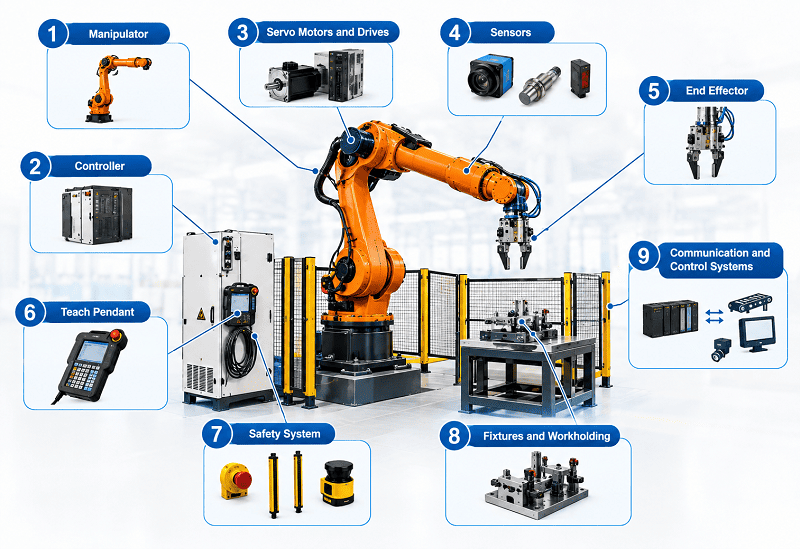
A typical industrial robotic system includes several important components.
1. Manipulator
The mechanical arm or robot structure that creates movement.
2. Controller
The computer system responsible for controlling robot movement and executing programs.
3. Servo Motors and Drives
These provide controlled movement to the robot’s axes.
4. Sensors
Sensors provide information needed for movement, positioning, inspection and safety.
5. End Effector
The tool attached to the robot that performs the actual operation.
6. Teach Pendant
A handheld interface commonly used to program, configure or manually move the robot.
7. Safety System
Depending on the application, safety systems can include guarding, interlocks, emergency stops, scanners, light curtains and other protective measures.
8. Fixtures and Workholding
Fixtures position and hold the workpiece so that the robot can perform the operation consistently.
9. Communication and Control Systems
Industrial robots may communicate with PLCs, conveyors, machines, vision systems and other factory equipment.
Advantages of Industrial Robots
Industrial robots can provide several benefits when correctly selected and integrated.
- Higher Productivity
- Consistent Quality
- Improved Worker Safety
- Reduced Repetitive Work
- High Repeatability
- Flexible Automation
- Data and Digital Integration
Limitations of Industrial Robots
Robots also have limitations.
- High Initial Investment
- Integration Complexity
- Skilled Workforce
- Maintenance Requirements
- Safety Requirements
How To Choose the Right Industrial Robot?
Before selecting a robot, manufacturers typically need to consider:
1. Payload
How much weight must the robot carry?
Remember that payload can include the workpiece and, depending on the manufacturer’s specification, the tooling or other loads that the robot must handle.
2. Reach
How far must the robot reach to complete the operation?
3. Number of Axes
Does the application require simple linear movement or complex multi-axis positioning?
4. Cycle Time
How quickly must the robot complete each operation?
5. Repeatability
How consistently must the robot return to a programmed position?
6. Work Envelope
Does the robot have sufficient movement range for the required workspace?
7. End Effector
What tool must the robot carry?
A gripper, welding torch, spray gun and grinding tool impose very different requirements.
8. Environment
Will the robot operate in:
- A cleanroom?
- A paint booth?
- A high-temperature environment?
- A dusty factory?
- A food-processing environment?
- A hazardous area?
Environmental requirements can significantly affect robot selection.
9. Safety
The robot application needs an appropriate risk assessment and safety design.
10. Integration
Consider how the robot will communicate with:
- PLCs
- CNC machines
- Conveyors
- Sensors
- Vision systems
- Safety systems
- Production-management systems
Frequently Asked Questions
1. What are the main types of industrial robots?
The major mechanical types include articulated, SCARA, Cartesian, delta, cylindrical and polar robots.
2. What are industrial robots used for?
Industrial robotics is utilized in tasks such as welding, painting, assembly, material handling, machine tending, palletizing, packaging, inspection, and cutting among many others in manufacturing.
3. How does an industrial robot work?
A computer sends command after command to the motors and drives in the robot which enables the machine to operate its axes. The robot uses sensors and other automation devices that offer data feedback while the end-effector performs a particular application.
4. What is the difference between a robot and a cobot?
A cobot is designed for applications involving closer human interaction under defined safety conditions. Traditional industrial robots are commonly integrated into controlled robotic cells. The distinction depends on the robot and the complete application.
5. What is a six-axis industrial robot?
A six-axis robot has six axes of movement that can be controlled independently allowing the robot to easily and precisely position and orient the tool in three-dimensional space.